What Are Salivary Gland Tumours?

Salivary gland tumours are abnormal growths that develop in the glands responsible for producing saliva. They can occur in the major salivary glands around the mouth, jaw and neck, or in the smaller glands found throughout the lips, cheeks, and throat.
Most salivary gland tumours are benign (non-cancerous), but some can be malignant (cancerous). A lump or swelling around the jaw, cheek or neck does not necessarily mean cancer, but persistent or unusual changes should be assessed by a doctor.
There are three pairs of major salivary glands:
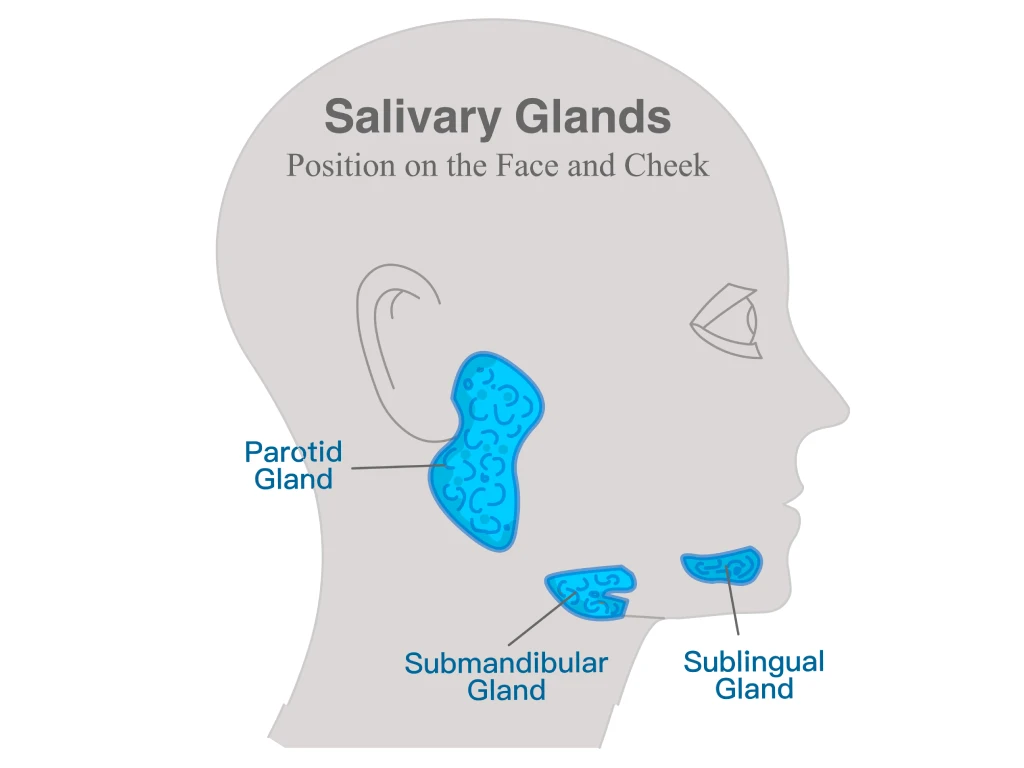
- Parotid glands: Located in front of and just below the ears. They are the largest salivary glands and are the most common site for salivary gland tumours.
- Submandibular glands: Located beneath the jaw.
- Sublingual glands: Located underneath the tongue.
There are also hundreds of smaller salivary glands throughout the mouth and throat. Although benign salivary tumours do not spread to other parts of the body, they can sometimes grow and affect nearby structures. Malignant tumours may grow into surrounding tissues or spread to other parts of the body.
What Are the Symptoms of Salivary Gland Tumours?
Some salivary gland tumours may not cause noticeable symptoms in the early stages. Others may present as a lump or swelling that gradually becomes more noticeable.
Possible symptoms include:
- A lump or swelling near the jaw, cheek or ear.
- A lump beneath the jaw or tongue.
- Persistent swelling in the mouth or neck.
- Pain around the affected area.
- Difficulty swallowing.
- Difficulty opening the mouth fully.
- Facial weakness or drooping.
- Changes in saliva production.
- A persistent sore or ulcer in the mouth.
A painless lump does not necessarily mean that the tumour is benign. Any persistent or growing lump around the face, jaw, mouth or neck should be assessed.
What Causes Salivary Gland Tumours?
The exact cause of most salivary gland tumours is not known. Certain factors may increase the risk of developing salivary gland cancer, including previous radiation exposure to the head and neck and certain occupational exposures. However, many people who develop salivary gland tumours have no obvious risk factors.
Treatment & Diagnosis

How Are Salivary Gland Tumours Diagnosed?
Your doctor will usually begin by examining the lump and asking about how long it has been present, whether it has changed, and whether you have experienced any other symptoms.
Investigations may include:
Ultrasound
An ultrasound scan can provide information about the size and characteristics of a salivary gland lump and may help guide a needle biopsy.
CT or MRI Scan
Imaging may be recommended to understand the size and location of the tumour and whether it involves nearby structures.
Fine-Needle Aspiration or Biopsy
A small sample of cells or tissue may be taken from the lump and examined in a laboratory to help determine the type of tumour and whether it is cancerous.
The combination of examination, imaging, and tissue sampling helps your specialist determine the most appropriate treatment.
Treatments for Salivary Gland Tumours
Treatment depends on whether the tumour is benign or malignant, as well as its size, location, and other individual characteristics.
Surgery
Surgery is a common treatment for salivary gland tumours, particularly when the tumour needs to be removed or when there are concerns that it may be cancerous.
The type of surgery depends on the gland involved and the location and extent of the tumour. Your surgeon will discuss the procedure and its potential risks and benefits with you.
Radiotherapy
Radiotherapy may be recommended for certain malignant salivary gland tumours, particularly when there is a higher risk of the cancer returning or when additional treatment is required after surgery.
Other Treatments
For advanced or recurrent salivary gland cancers, additional treatments may be considered depending on the specific type and characteristics of the tumour.
Treatment is usually planned according to the individual patient and may involve a multidisciplinary team.
When to See a Doctor?
See a doctor if you notice a lump or swelling around your ear, jaw, cheek, mouth or neck that does not go away or continues to grow.
You should also seek medical assessment if you experience:
- A persistent lump in the face, jaw or neck
- Facial numbness or weakness
- Difficulty swallowing
- Persistent pain or swelling
- A change in the appearance or movement of one side of your face
- A lump that is increasing in size
These symptoms can have many causes and do not necessarily indicate a tumour. However, getting persistent changes assessed can help identify the cause and determine whether further investigation is needed.
Book an AppointmentFrequently Asked Questions (FAQ)
No. Many salivary gland tumours are benign, but some can be cancerous and require further investigation and treatment.
A salivary gland tumour may feel like a lump or swelling around the ear, jaw, cheek, mouth or neck. It may be painless, so a lack of pain does not necessarily mean that the lump is harmless.
See a doctor if a lump around your jaw, cheek, ear, mouth or neck persists, grows or is accompanied by symptoms such as facial weakness, numbness or difficulty swallowing.
Treatment may involve different specialists depending on the diagnosis. Dr Natascha Putri, General Surgeon at TEN Surgery, has subspecialty expertise in salivary gland diseases and conditions affecting the head and neck.