What Are Breast Microcalcifications?
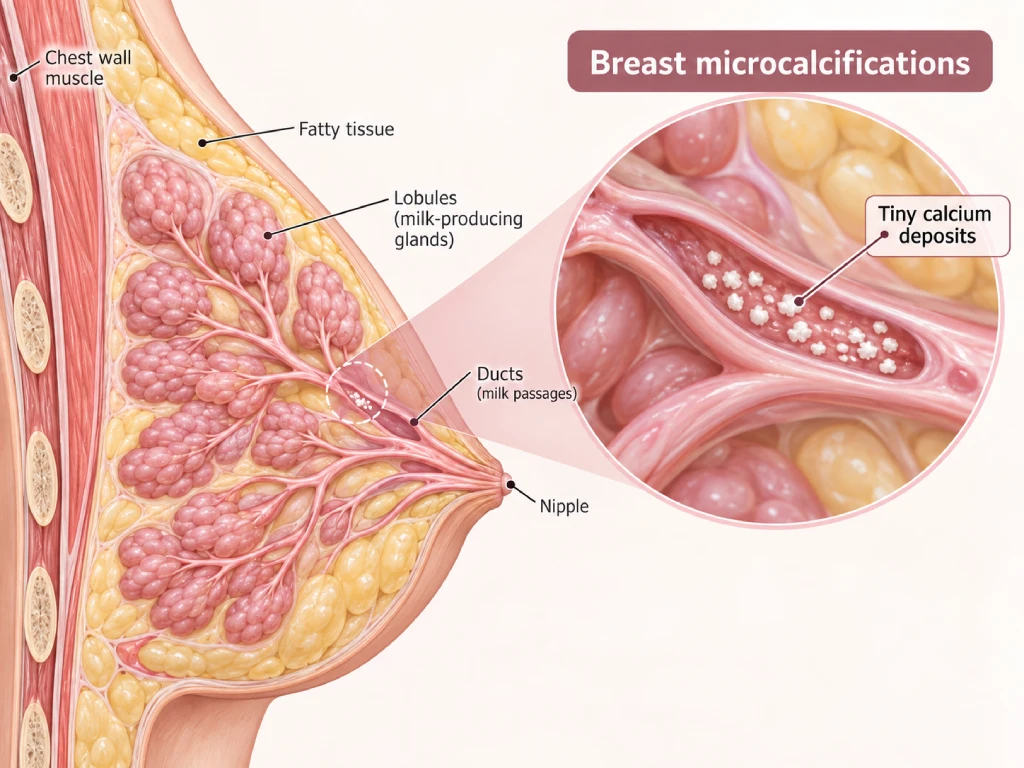
Microcalcifications are tiny calcium deposits within breast tissue. They are commonly detected on mammograms and are usually too small to be felt.
Most microcalcifications are benign. However, certain patterns and distributions of microcalcifications may be associated with precancerous changes or early breast cancer and require further assessment.
How Do Microcalcifications Develop?
Microcalcifications develop when tiny deposits of calcium form within the breast tissue. They may occur as part of age-related breast changes, benign changes within the breast, inflammation, previous injury or surgery or, less commonly, precancerous or cancerous changes.
Signs and Symptoms
Microcalcifications usually cause no symptoms and are most often detected during breast screening.
Causes
Common causes include:
- Fibrocystic changes
- Previous breast surgery or inflammation
- Age-related breast changes
- Ductal carcinoma in situ (DCIS)
- Early breast cancer
Managing Breast Microcalcifications
Treatment and Follow-up
Management depends on the size, pattern and distribution of the microcalcifications on mammography.
Options may include:
- Routine mammographic follow-up
- Short-term imaging surveillance
- Image-guided (stereotactic) biopsy
Prevention
There is no known way to prevent breast microcalcifications.
When to See a Doctor

You should seek medical review if:
- Microcalcifications with concerning features are detected on mammography
- Microcalcifications are associated with other suspicious changes on mammography
- Additional imaging or biopsy has been recommended
- You have other symptoms e.g. new nipple discharge, breast lump or skin changes
Frequently Asked Questions (FAQ)
No. Most microcalcifications are benign.
A biopsy may be recommended when the pattern of calcifications raises concern for precancerous or cancerous changes.
Most microcalcifications do not disappear. Some benign microcalcifications remain stable over time while others may gradually change. They usually do not require removal unless further investigation identifies an underlying abnormality.
Most microcalcifications can only be detected on mammography because they are too small to be seen on ultrasound or felt during a breast examination.
Available at

TEN Surgery Group (Gleneagles) - Dr Tan Qing Ting